Sustainability
The goal is clear: Stena Line’s target is to reduce its carbon dioxide emissions by 30 percent by 2030, compared with 2019 levels.
“There is no single solution that delivers 30 percent immediately. We need to work with many different measures in parallel and continuously calculate the benefits,” says Hans Corneliusson, Group Head of Fleet Support at Stena Line.
A technical and commercial puzzle
Passenger and RoPax vessels are normally dry-docked twice during a five-year period. The larger dockings, known as special surveys, are extensive and governed by classification rules. During these, the hull, valves, propeller shafts and anchor chains, among other components, are inspected.
At the same time, Stena Line takes the opportunity to carry out its own improvement measures while the vessel is out of service.
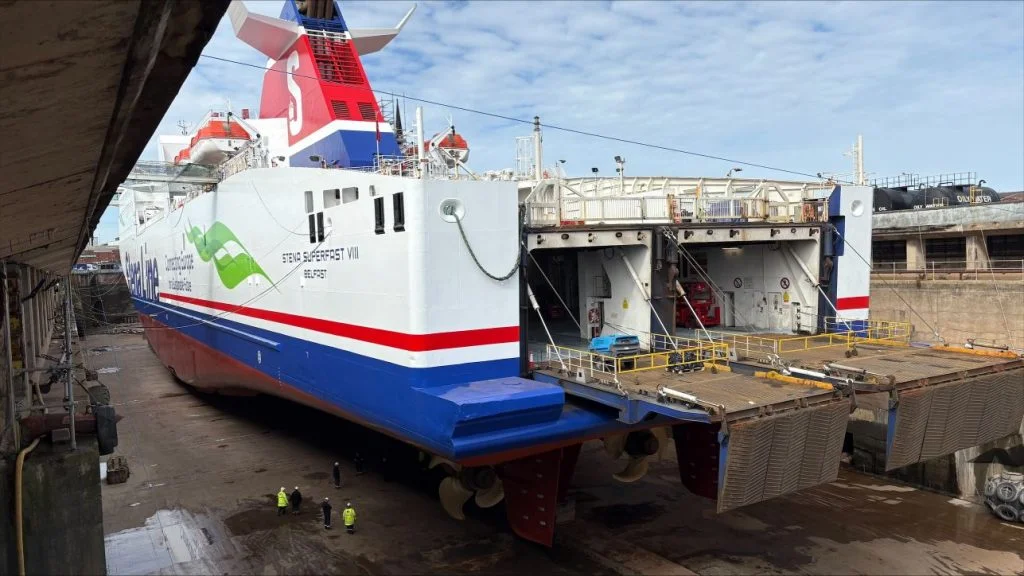
“When the vessel is out of operation, we have full access. That allows us to carry out work that would otherwise be impossible, both below the waterline and in engine rooms and systems,” says Hans.
Planning is complex. Dockings must be coordinated with timetables, replacement vessels, shipyard capacity and technical dependencies. Between December 2025 and April 2026, 15 of Stena Line’s total of 40 vessels have been in dry dock.
The hull – major gains below the waterline
One of the most effective measures takes place where it cannot be seen – beneath the water surface. By blasting the hull completely clean of old paint, a smooth surface is created that reduces friction against the water.
“Blasting and repainting with a conventional coating alone can reduce fuel consumption by up to 2 percent per vessel,” says Hans.
After blasting, a silicone-based hull coating is often applied, further reducing resistance. This can provide savings of approximately up to 3–3.5 percent, and also reduce the need for maintenance between dockings.
Propellers adapted to today’s operations
Further efficiency gains are achieved through the propellers. Many older vessels were built for higher speeds than they operate at today. By adapting the propeller blades to current operating conditions, efficiency is improved.
“On vessels where we only replace the propeller blades, we see up to a 2 percent reduction in fuel consumption. That is significant, both from a climate and financial perspective,” says Hans.
In addition, continuous technical improvements are carried out in the engine room and onboard systems during and between dockings.
Innovation driving development
In addition to established measures, Stena Line is also working to test new technologies during dockings. These include new rudder solutions and so-called air lubrication, where small air bubbles along the hull further reduce friction in the water.
Each measure is carefully evaluated, also financially. The payback period averages between 1.5 and 2 years, sometimes shorter when fuel prices are high.
A strategic tool
By combining necessary maintenance with technical improvements, dry docking has become a strategic tool in Stena Line’s transition.
Each docking contributes to lower emissions, reduced fuel costs and a more energy-efficient fleet – step by step toward the 2030 target.