Sustainability
Food waste has a significant negative impact on the environment. According to the World Wildlife Fund (WWF), discarded food accounts for up to 10 percent of global CO₂ emissions.
As part of our ambition to reduce greenhouse gas emissions – and to make better use of our financial resources – the Food & Beverage team has worked with a strong focus on reducing food waste.
“When reviewing how we could both reduce raw material costs and become more sustainable in our kitchens, we identified overproduction as the key area where we could make a difference,” says Niclas Lilja, Stena Line.
Culture, ways of working, and attitudes
With extensive experience from restaurant kitchens, Niclas and Jakob quickly realised that working practices in the kitchens onboard differed significantly from those on land. Changing culture, ways of working, and attitudes became the foundation for success.
Traditionally, food onboard was prepared in advance, kept warm, and served in trays and containers. The kitchens themselves were also designed to support this way of working.
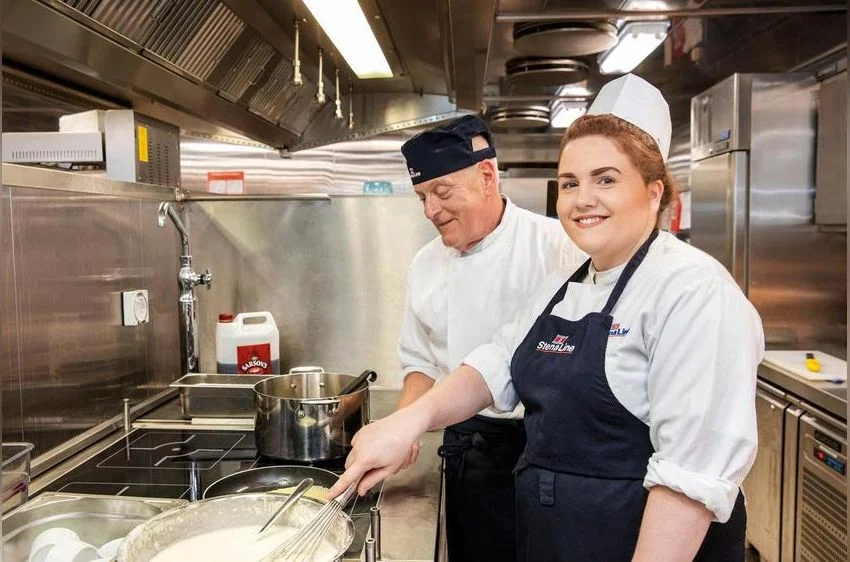
To test a new approach – preparing food to order – Niclas and Jakob stepped into the kitchens and together with the onboard crew demonstrated how it could be done.
“We started with two dishes: burgers and fish & chips – two of our bestsellers – and handwritten order tickets. We stood there cooking burgers to order to show that it worked,” says Jakob.
Since then, the number of dishes prepared to order has increased. Meals are now plated and served fresh, with improved quality and presentation.
This new approach has required changes on several levels. Schedules and working hours have been adjusted so that chefs are present when guests are dining. Kitchens have also been adapted to support the new concept, known as Cook Fresh on Order.
“I would describe it as a paradigm shift in how we work – how we schedule, how we view ingredients, how we handle food, and how we plan,” says Niclas.
From intuition to a data-driven approach
A key factor in reducing food waste has been adopting a more systematic and data-driven approach to planning purchases and production. Sales data provides insights into how many passengers choose to dine onboard and what they prefer to eat.
“We’ve moved away from making decisions based on gut feeling, thinking ‘this is probably how much we’ll need.’ Instead, we aim to be data-driven in everything we do and only purchase what we actually plan to cook,” Jakob explains.
Reduced waste, higher job satisfaction, and improved financial performance
Changing established routines has required clear communication and the ability to demonstrate positive results, something that has gradually become evident as the new ways of working have been implemented.
“One clear benefit for our staff is that it has become more enjoyable to work in the kitchen, as the quality of the food we prepare has improved,” says Niclas.
Jakob adds:
“Serving a dish plated to the guest and receiving immediate feedback: ‘What a great burger’, is very rewarding.”
“Another positive effect is reduced workload – less raw material to load and unpack, and less leftover food to manage,” Niclas continues.
Both Niclas and Jakob stress the importance of the engagement from all the head chefs and their teams.
“We’ve had a fantastic response from them, and they have adopted the new practices and processes very positively. Huge credit needs to go to these guys”, says Niclas.
Most importantly, the initiative has led to significantly reduced food waste and substantial cost savings. In 2024, raw material costs decreased by just over SEK 22 million, followed by savings of SEK 10 million in 2025. The target for 2026 is to save an additional SEK 10 million.
Based on an average raw material cost of SEK 50 per kilo, this corresponds to a reduction of more than 600 tonnes of food waste during 2024–2025.
The next step for Niclas, Jakob, and their team is to explore how more efficient approaches to breakfast and buffet services can further reduce food waste.
“We continuously see new opportunities,” Niclas concludes.