Sustainability
New ships and innovative concepts featuring the latest sustainability technology and striking design often capture attention and become symbols of our environmental ambitions. But just as important are the many initiatives quietly taking place across our existing fleet — work that has a significant impact on reducing our environmental footprint.
“A vessel can have a lifespan of 30 to 50 years. During that time, technology and regulations change a lot. That’s why we constantly need to adapt with new technical solutions along the way,” explains Richard Rindevret, Fleet Project.
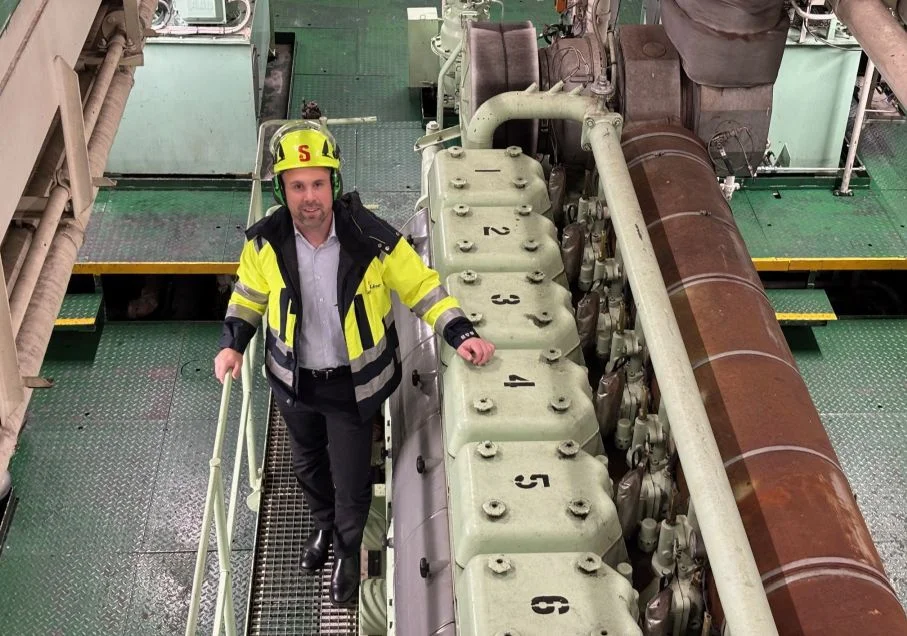
Smart engineering that cuts emissions and saves energy
Within Stena Line’s Fleet organization, around 50 project initiatives are currently underway across six teams, all part of Stena Line’s Decarbonisation Roadmap 2.0 and focused on finding ways to save fuel and energy — reducing both emissions and costs. Richard, who leads Mechanical Optimisation Projects, shares five examples:
1. Compressed Air Compressor Retrofit
By replacing the air compressors onboard, we can both match air production to actual demand and have the compressor run at optimal speed at all times. This upgrade cuts electricity use by almost 50% and will be rolled out across 20 vessels.
2. Absorption Chiller Retrofit
Surplus heat generated onboard is reused to produce cooling. This solution reduces electricity consumption for cooling by more than 90% compared to conventional chillers. It will be installed on five vessels, with the first implementation planned for spring 2026.
3. Green Filter Systems Retrofit
Conventional purifiers used for removing water and particles from lubricating oil are being replaced with filters made from surplus wool. Unlike separators, which require oil to be heated to 90–95°C, the new filters don’t need preheating, which achieves over 90% lower power use compared to conventional separators. They also eliminate sludge, the residual waste product. The new system will be installed on 23 vessels.
4. Fuel Valve Optimisation
By installing Autosync injectors, which inject exactly the right amount of fuel needed at the exact right time results in an up to 4% reduction in fuel consumption, cleaner combustion and lower exhaust emissions. Part of a pilot study, the system will be installed on the Stena Adventurer and hopefully rolled out across more vessels later
5. Waste Heat Recovery
Excess heat is recovered to generate electricity and/or heating. By installing an exhaust gas boiler on the auxiliary engines, surplus heat can be extracted while the vessel is in port, and be used to produce steam, which in turn heats the vessel or generates electricity. The system will be installed on Stena Scandica as part of a pilot study. The savings are substantial: each year, the measure reduces CO2 emissions equivalent to 11 round trips on Stena Scandica’s Nynäshamn–Ventspils route. The system will hopefully be rolled out across more vessels after a verification period.*
Passion and teamwork behind every idea
Many small projects like these add up to major savings and real progress. But how do the ideas come to life? According to Richard, engagement throughout the entire organisation is a big part of the answer.
“You have to be passionate about it. The best ideas can come from anywhere, it’s about capturing them. Part of the job is staying curious and keeping an eye on what’s happening in the world, like attending technology fairs. We also get approached by suppliers developing new solutions. This is a living project, it constantly needs fresh ideas. It’s also about educating the crew and getting everyone to pull in the same direction.”
And he adds:
“Projects that were not economically viable a few years ago can now make strong financial sense as higher oil prices and stricter penalties change the equation. At the same time, many established technologies have advanced significantly, becoming far more efficient and effective than before.”
A key advantage is also the collaboration within the Stena Group, which includes companies at the forefront of ship technology development.
“By working together within the Stena family, with Stena RoRo and Stena Teknik, we can align our efforts and move forward as one.”, concludes Richard.
* All stated savings, reduction percentages, and performance figures are based on internal energy audits (2024–2025), supplier specifications, and test results on selected Stena Line vessels. Comparisons refer to the conventional equipment previously used onboard the vessels, unless otherwise specified.